

What's new
A new write-up on Substack, the radar moving up the mast, and two build pages rewritten from the keel up.
The radar goes up the mast
A HALO20 bought as a bundle with a Simrad GO9 XSE — and moved off the stern pole onto a $395 mast mount. More range, a stiffer mount, a quarter of the price, and one blind wedge astern.
New on Substack · September 2026Portable Solar Powered Water Maker from Sea Water
Building a portable solar-powered reverse osmosis 12-volt system — why we're doing it, and what it takes to push seawater through a membrane at 800–900 psi.
Updated · Fresh WaterThe watermaker build log
Now with the full plumbing diagram, a buy-to-spec parts table, the wiring, and how to run the thing gently enough that the membrane lasts.
Updated · SolarThe 400 W rack design
The design is finished and published — panels, arch, margins and mounts, right down to the cut list.
Latest adventure: meet Grimace
Not every day on the water goes according to plan. Some days there's a rock with a name.
Skipper Scott vs. a rock named Grimace
We put the whole thing on camera, because the point of this channel is showing how it actually goes — the good runs and the ones you'd rather not talk about. If you learn something from watching us find Grimace the hard way, that's a win.
Four hundred watts you can take down in ten minutes
Seven revisions to get 400 watts over the cockpit — and then to get 48 pounds of it back off again before we sail. Every dimension, part number and load calculation is on the page.
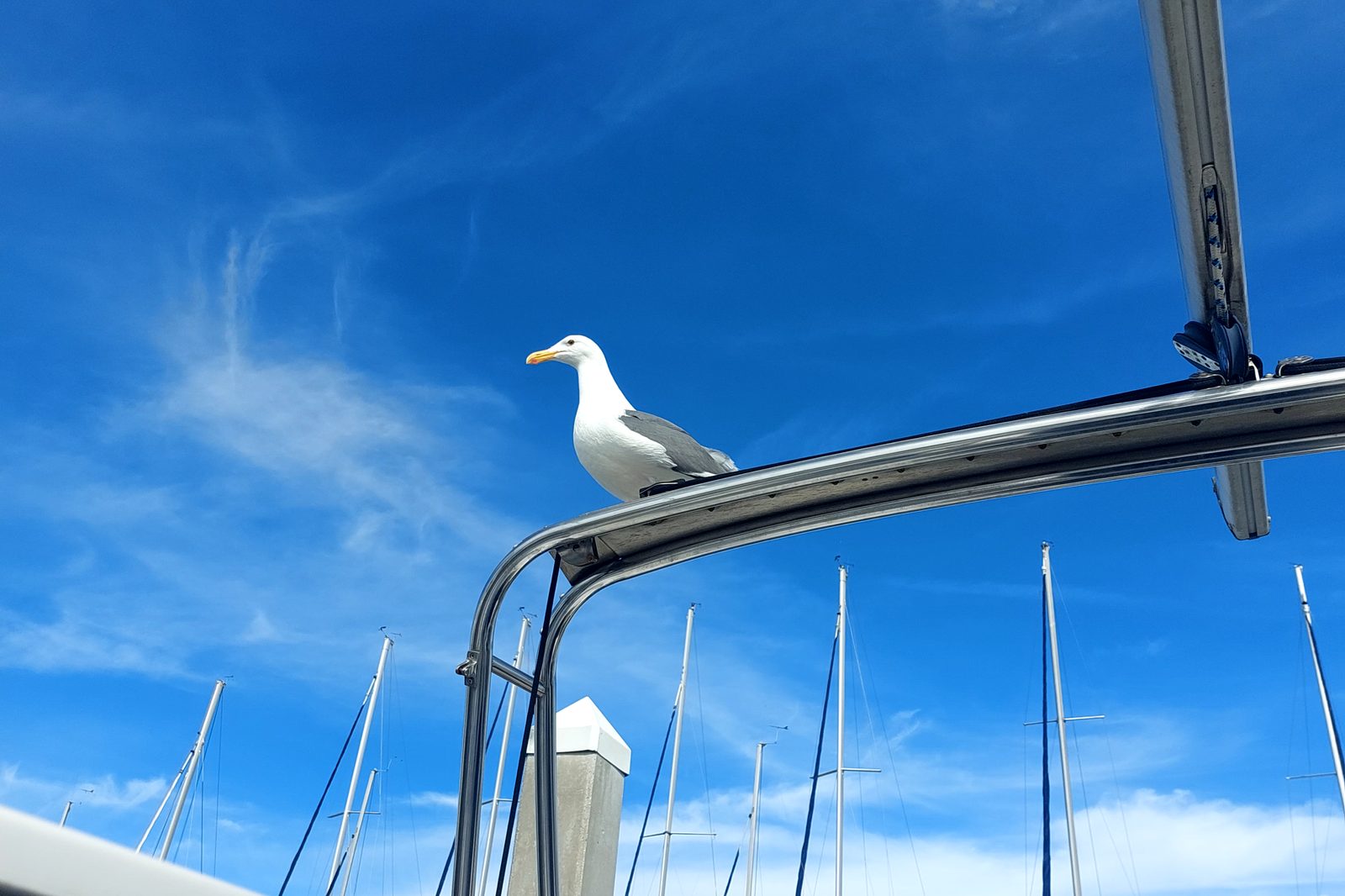
Where it's going. The rack clamps to this arch — out where the top rail bends down toward the deck.
What's going there. Aft view — two panels, an 18-inch slot, no new deck penetrations, and four pins holding the lot on.
Why the panels come off before we sail
Boaty is a 7,400 lb coastal cruiser heading for Cabo, and 116 lb bolted seven feet above the cockpit comes straight out of the righting moment that keeps her upright when it turns rude. So Rev G hooks and pins instead of bolting: the panels lift off in ten minutes and stow in the quarter berth, and the frame that's left can be built from much lighter tube. 46% less weight-moment aloft when it matters.
Travels, how-tos, and open source boating
Follow along with the journey aboard the Hunter 290 — the adventures, the builds, and the videos that show you exactly how we do it.
From The Skipper
Welcome aboard! Firing up the SS Minnow again and getting ready for another season of adventures on the water. We're working on our Hunter 290 and getting her ready for longer trips — subscribe on Substack to follow along.
Fresh water for under $1,000
We priced out making our own drinking water at sea on 12 volts. Short version: there's no such thing as a $1,000 watermaker, you can build one for about that, and then we decided not to. Read the whole write-up →
The radar goes up the mast
The HALO20 is bought — as a bundle with a Simrad GO9 XSE for the helm. And it isn't going on the stern pole after all. A Scanstrut mast mount puts the dome about six and a half feet higher for roughly a quarter of the price of a decent pole kit, and a mast is a far stiffer thing to hang a radome from than eight feet of tube. The cost is a narrow blind wedge dead astern, and a cable to get down a furling mast. See the mast-mount design →
Rev M — the holes were already there
Four revisions were spent contorting the rack to clamp outboard of the traveller plate, because you can't grip a tube where a plate is welded to it. Then a photo taken from underneath the arch showed four empty bolt holes drilled clean through that plate, 18 inches in from each end, left over from a fitting nobody remembers. They are 9/32, in two rows straddling the traveller rail, in a plate that measured 5/16 thick — which is exactly the thickness that makes the whole vertical stack close with no shim. Two rail clamps, two risers and three pounds of stainless just went in the bin. See the new front pickup →
Rev I — a panel that sails with us
The honest hole in the last design was that nothing charged while we sailed. Now one panel latches flat to the coach roof on a cradle made from the same tube as the rack, spaced to match it exactly, so the panel's own hooks and pins fit in both places. Roughly 200 watts still working on passage. See how it latches →
A radar pole, and the brace that pays for it
A Simrad HALO20 goes on eight feet of stainless on the port quarter. Bolted to the deck on its own it would need 3-inch tube; braced off the solar rack's aft crossbar it can be 2-inch — sixteen pounds saved, all of it high up. And the pole props the rack right back. Since retired — the radar went up the mast instead.
Rev G — the panels come off now
We ran the stability numbers for the Cabo passage and didn't like them. So the panels hook and pin instead of bolting: four pins, ten minutes, and 48 pounds goes from seven feet up to the quarter berth. The frame got lighter too, because it no longer has to survive a gale with the glass still on it. See the whole design →
Skipper's wisdom
If you find reliable boat maintenance people, buy them dinner — they're like unicorns.
Staying cool without a five-figure refit
12-volt fans first — that's the next video. And when we've gotta have real AC, we run the generator: the DC and solar setups were wildly expensive, so we got a splitter and converter to run off generator or dock power instead. Read how we decided →
What's on deck
Ordering the stainless for the solar rack, and somebody going up the mast in a bosun's chair with a tape measure — spreader height, what's in the way on the forward face, and whether the radar cable can get down past the furling foil.
Our Boat
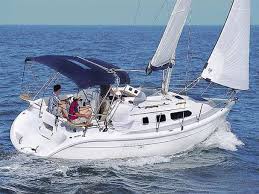
Meet the SS Minnow — our Hunter 290. She's a roomy, easy-sailing cruiser that we're refitting bit by bit and taking out for longer adventures. Every upgrade, repair, and shakedown run becomes a video so you can follow the whole journey.
Boating on a budget. We don't have a big 42-foot blue water boat — we've got a "picnic cruiser," and we're making her off-the-grid capable without breaking the bank. Every build is picked to punch above its price, so you can do the same with the boat you've already got.
- Hunter 290
- Sloop rig
- AGM house bank
- 400 W solar · Rev N
- HALO20 radar · on the mast
- Simrad GO9 XSE
- Open source nav
400 watts over the cockpit
Two Renogy 200W panels on a stainless rack that clamps to the arch we already own — and lifts off in ten minutes so the weight goes below before we sail. Drawings, cut list, hardware and load numbers, all published.
See the solar designA HALO20, up the mast
The spec sheet says 24 nautical miles. The curvature of the earth says about 5 from fourteen feet up the mast — which still beats the 4.2 an eight-foot pole would have bought. Range math, the blind wedge astern, and how one radar talks to a GO9 XSE and OpenCPN at the same time.
See the radar designWater for a 40-gallon tank
What $1,000 actually buys in a 12-volt watermaker, the power math on a 290, and the $400 plan we picked instead.
Read the water write-upOpen Source Boating
Open source boating is the whole idea: when you're out on the water you need to be able to service your own gear — so why should your tech be any different? We show you how we build ours, and you build your own.
Subscribe to our YouTube channel to see the how-tos behind every system aboard:
- Ubuntu on the Raspberry Pi — a high-performance, low-power desktop
- Bareboat Necessities — integration with radio, GPS, navigation and more
- Home Assistant — smart boat Internet of Things integrations
- OpenPlotter — a marine-ready Raspberry Pi platform for navigation and sensors
- Signal K — an open data standard that gets all your boat's systems talking
- OpenCPN — free, open source chartplotting and route planning
- pypilot — an open source autopilot that steers the boat for you
Our own build write-ups live here too — the 400 W solar rack design and the mast-mounted radar that talks to OpenCPN, both published right down to the parts list, plus fresh water aboard a Hunter 290 and off-the-grid air conditioning.
Want the story behind the builds? The boat write-ups go out on Skipper Scott's Substack. Analog Scott's other work lives elsewhere — Looptah, and Talking to the Machine.
Come along for the ride
Every build on this boat gets filmed and written up in full — the numbers, the parts lists, and the bits that went wrong. Subscribe on YouTube to watch it happen, and on Substack to get the write-ups in your inbox.
Or open it on Substack. And subscribe on YouTube — the mast job goes up there first.